
7 Signs Your Garage Door Spring Is Broken or Failing
A garage door spring usually announces its failure with a loud bang from the garage, but some springs fail quietly over weeks. This post covers seven signs a spring is broken or failing, what to do in the first ten minutes, and why pressing the opener button again is the most expensive mistake you can make. There are no repair steps here, because spring work is not a DIY job — just how to recognize the problem and respond safely.
Request Service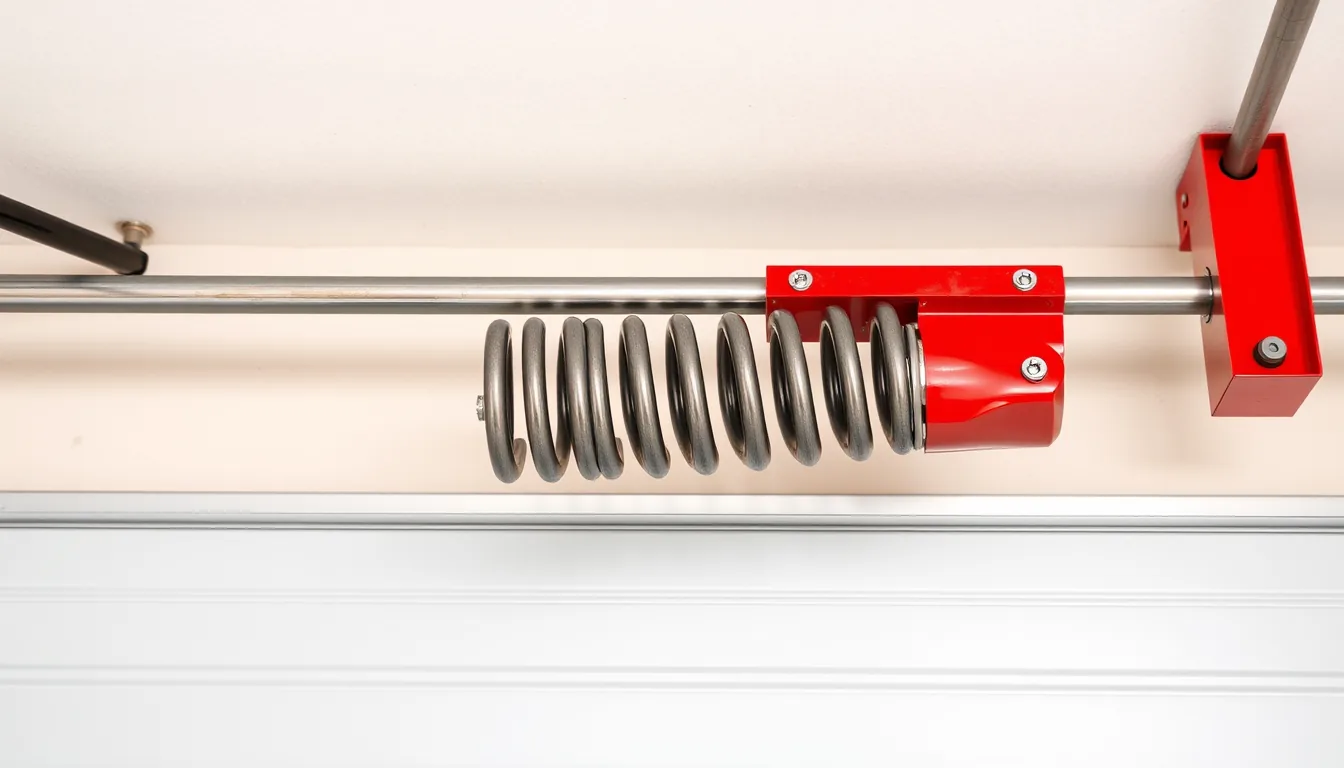
The First Ten Minutes After the Bang
If you just heard a sharp bang from the garage, treat the door as unsafe until you know why. A torsion spring lives on a steel shaft above the door opening, wound tight enough to lift the entire door. When the coil snaps, all of that stored energy releases in a fraction of a second, and the sound carries through the house like a firecracker. Most springs break while the door is sitting closed or moving out of the closed position, because that is when a torsion spring is wound tightest and an extension spring is stretched furthest — which is why the bang so often comes from an empty garage with nobody near the door.
In the first ten minutes: keep kids and pets away, do not press the opener button again, and leave the door exactly where it is. Do not pull the red emergency release cord while the door is open. With a broken spring, releasing the opener trolley can let a very heavy door free-fall. From a safe distance, look at the spring above the door: a broken torsion spring shows a clear gap, often about two inches wide, between the separated halves of the coil.
Seven Signs, From Obvious to Easy to Miss
Some spring failures are dramatic and some are gradual. Here are the seven signs to check:
- The bang. A torsion spring unwinding all at once is loud enough to be mistaken for something hitting the house.
- A gap in the coil. A healthy torsion spring is one continuous coil; a broken one shows a visible split, commonly around two inches.
- The door lifts about six inches and stops. The opener's force limit senses it is dragging dead weight and reverses or quits. This is a classic broken-spring pattern, not an opener defect.
- A crooked door. On doors with two torsion springs, or with extension springs mounted one on each side above the horizontal tracks, a single failure lifts one side more than the other and cocks the door in its tracks.
- Slack or draped cables. Spring tension keeps the lift cables taut. Loose cable loops near the bottom brackets often mean the spring behind them has let go.
- The door slams shut. A door that used to close smoothly but now drops the last few feet is losing its counterbalance.
- Rust, pitting, or stretched coils. Rust wears the spring wire and eats into its remaining cycle life. For extension springs, do the stretch check with the door fully open, when the spring is relaxed: a healthy spring's coils sit tight against each other in that position. Daylight between the coils with the door open means the spring has stretched out and lost tension. Gaps with the door closed are normal — the spring is at full stretch then, and every healthy extension spring shows separation under load.
Why Waiting Makes Everything More Expensive
The spring, not the opener, does the actual lifting. A residential sectional door is a heavy assembly — often 130 pounds or more for a single steel door, and much more for an insulated double — and the opener is only built to guide a balanced door. Running it against a dead spring can strip the trolley carriage, wear the drive gear, or bend the top panel section where the opener arm attaches, turning one repair into several.
Slack cables bring their own risk: they can jump off the cable drums, which adds a re-cabling job to the spring work. And if your door has two springs, the survivor was installed at the same time and carries the same cycle count, so it is now hauling double load on borrowed time.
What Not to Do
A wound torsion spring stores enough energy to lift the whole door, which is exactly why it is dangerous to touch. Do not loosen the winding cones, the set screws, or the bottom brackets, and do not try to unwind or adjust a spring with any tool. These parts stay under load even with the door closed, and they cause serious injuries. Skip the two-person manual lift as well; a door without its counterbalance can drop faster than anyone can react.
What you can safely do: photograph the spring from a distance, note whether it sits above the door opening (torsion) or runs along the horizontal tracks (extension), and unplug the opener so nobody in the house cycles it out of habit.
What to Do Next
Write down what you observed: the bang, the coil gap, whether the door rises a few inches and stops, whether it is stuck up or down, and how many springs you can see. Then submit a service request through the form on our contact page and describe it. Those details help a technician assess the door and measure for the correct replacement — wire size, inside diameter, and spring length all have to match the door's weight — and check the cables, drums, and center bearing while the assembly is apart, since a snapped spring often shocks its neighbors.
Frequently Asked Questions
One of my two torsion springs broke. Can the door keep running on the remaining spring?
It is risky. Both springs were installed together and share the same cycle count, so the survivor is near the same fatigue point and is now carrying the entire load. The opener also has to fight the missing counterbalance, which wears its drive gear and trolley. A technician will usually recommend replacing both springs at the same visit so the new pair wears evenly.
My spring never made a bang — it just looks rusty and stretched. Is that urgent?
Treat it as a warning, not a curiosity. Rust pits the spring wire and shortens its remaining cycle life. Check an extension spring with the door fully open, when the spring is relaxed: healthy coils sit tight together, so daylight between them in that position means the spring has permanently stretched. Springs usually let go with the door closed, when the load peaks, so submitting a service request before it snaps means the door never strands your car inside.